
Testing Core Stability - Double Leg Lowering Assessment
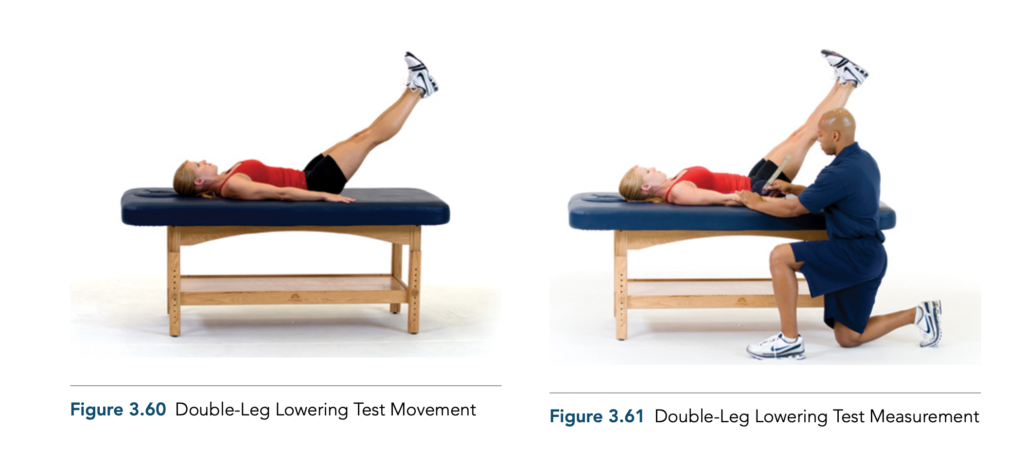
Purpose:
- The double-leg lowering test is one test with which the sports performance professional can effectively assess neuromuscular control and strength of the core.
Procedure and Position:
- Individual is placed in a supine position, with a flat blood pressure cuff under the lumbar spine at approximately L4–L5.
- The cuff pressure is raised to 40 mm Hg.
- The individual’s legs are maintained in full extension while flexing the hips to 90 degrees (or to the amount of hip flexion that does not cause a posterior pelvic tilt).
- The individual is instructed to perform a drawing-in maneuver (pull belly button to spine) and maintain while keeping their lumbar spine in contact with the pressure cuff.
Movement:
- The individual is then instructed to lower their legs toward the table while maintaining the drawing-in maneuver.
- The test is over when the pressure in the cuff decreases (Back arches due to synergistic dominance of psoas) or the pressure increases as the client allows the abdominal wall to protrude and synergistically compensate with the rectus abdominis and the external obliques.
- The hip angle is then measured with a goniometer to determine the angle.
- Core stability strength is determined by the below score:
- 50% = Poor
- 60% = Fair
- 80% = Good
- 100% = Normal